

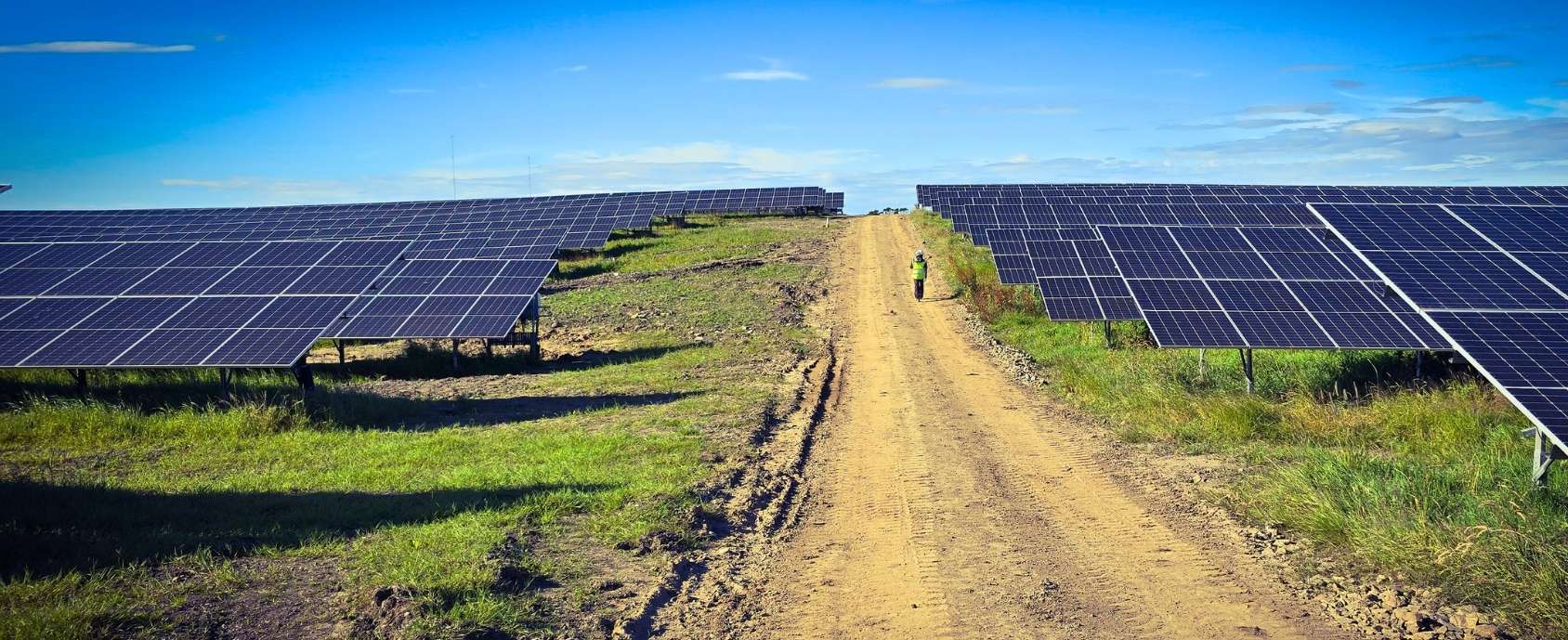
Britain has set itself one of the most ambitious deployment targets in its energy history. Clean Power 2030 requires roughly 47 gigawatts of solar capacity, meaning the UK needs to build approximately 25 gigawatts of new solar in the next five years. That is more than has been built in the entire history of the industry here to date.
The capital exists at a global scale that would have seemed implausible a decade ago. According to the IEA’s World Energy Investment 2026 report, clean energy is now attracting nearly twice the investment of fossil fuels: $2.2 trillion projected for clean energy and electrification this year, against $1.2 trillion for oil, gas and coal combined. Renewables now account for 70% of all global power generation spending. The argument that capital is afraid of clean energy has been settled. It isn’t.
And yet, at Solar and Storage London 2026, panel after panel returned to the same uncomfortable question: why does so much of that capital remain cautious, slow-moving, or absent from the specific projects that need it, and why, in a market as mature and policy-supported as the UK, does the gap between available capital and deployed gigawatts remain so stubbornly wide?
The answer is not that UK solar is too risky. It is that UK solar is too poorly understood at the project level, and that the gap between perceived risk and actual risk is costing the energy transition time it does not have.
A market worth investing in
The macro picture and the project-level reality are, at present, telling different stories.
Globally, the investment case for clean energy has never been stronger. But that $2.2 trillion is not distributed evenly. It flows towards the clearest risk profiles, the most standardised asset classes, and the most established markets. The question for the UK is not whether global capital is available in aggregate; it clearly is, but whether UK solar and storage projects are consistently presenting themselves in a form that capital allocators can act on with confidence.
On the fundamentals, they should be, and the UK offers genuinely strong conditions.
On battery storage regulation, the UK is genuinely ahead of most European peers. A functioning revenue stack (merchant ancillary services, the capacity market, co-location structures) gives storage assets multiple routes to revenue that markets like Spain are still working to establish. The CfD framework, for all its current tensions around negative pricing and curtailment, provides a degree of revenue certainty that many comparable markets cannot match. Planning and permitting, while far from frictionless, have in recent years moved faster than in several continental European markets.
The UK also has 7.5 gigawatts of co-located solar and storage projects due to reach financial close by 2027, a figure that represents a near-quadrupling of current co-location capacity. That pipeline exists because developers and some investors have already done the work to understand the opportunity. The challenge is extending that confidence more broadly.
So what are the investment risks?
In our experience, risk mispricing tends not to stem from technological limitations, but rather the underestimation of the risks present during development, combined with the overestimation of certain risks that experienced operators have long since learned to manage.
Planning is the clearest example. UK solar development has accelerated significantly, but the consenting process remains genuinely unpredictable in ways that financial models rarely capture. Local opposition is not always visible at the point of site selection, design changes introduced through the consenting process can affect project economics materially, and consent, when it comes, does not end the risk. Conditions, obligations, and community engagement requirements continue well beyond approval. For investors who haven’t lived through a full UK development cycle, this is a source of real uncertainty. For those who have, it is a manageable risk that can be underwritten with the right expertise and the right project-level structures.
End-of-life planning is the equivalent risk on the operational side. The UK’s first wave of large-scale solar assets built under Renewable Obligation Certificates from around 2010 onwards is approaching the end of its subsidy period. How those assets perform through the transition, what decommissioning obligations look like in practice, and what the repowering economics are are questions that the original investment frameworks never fully addressed. Investors in new-build projects would do well to ensure these questions are asked explicitly at the outset, rather than discovered later.
The risks that genuinely are underpriced
Several categories of risk are routinely missing from project valuations in ways that matter financially.
The grid: the problem that makes everything else harder
No honest assessment of UK solar investment risk can avoid the connection crisis.
The grid was designed for a world of large, centralised, dispatchable power stations. What is arriving instead is distributed, variable generation at a scale and pace the system was not built to accommodate. The collision between those two paradigms is producing the curtailment, negative pricing, and revenue cannibalisation that are now suppressing captured revenues even as the physical value of solar generation increases. This is not a technology failure. It is a market architecture problem.
The connections reform process is attempting to address it, but it is doing so under pressure and at pace, and the uncertainty it creates is genuine. Projects that reached the connection queue under one set of assumptions are being re-sequenced under a different framework. Developers who have navigated this process understand its logic; investors who haven’t can reasonably find it alarming.
The long-run answer is grid modernisation of a kind that most European countries are also grappling with. The analogy is useful: much of the developing world bypassed fixed-line telecommunications entirely and went straight to mobile infrastructure designed for the technology that was actually coming. The UK’s grid is the energy equivalent of a 3G network being asked to handle 5G traffic. The upgrade is necessary, the direction is clear, but the transition period is one in which risk management matters more, not less.
What helps in the interim is co-location. Battery storage paired with solar assets provides a partial buffer against negative pricing and curtailment, and the regulatory framework for it in the UK is more developed than in most comparable markets. The growth in the co-location pipeline is not coincidental; it reflects developers and investors adapting their risk posture to the current market reality.
Labour: the constraint that isn't in the model
Of all the risks facing the UK’s CP30 ambitions, the labour shortage may be the one most consistently absent from investment analysis.
Building 25 gigawatts of solar in five years requires people. Not just in large numbers but in skilled trades and at pace, competing with every other major infrastructure programme running concurrently. Housing, offshore wind, rail, data centres: all of them are drawing on the same underlying pool of qualified labour. At current build rates, the solar and storage sector does not have enough trained workers to hit the target, and the training pipeline to produce them operates on a timescale that does not align neatly with a 2030 deadline.
This is not an abstract concern. Labour is now the single largest cost component on a UK solar build, approximately 30% of the total project cost, more than panels, more than framing, more than inverters. It is also the component most sensitive to scarcity: when qualified people are in short supply, costs rise, programmes slip, and build quality suffers. The three outcomes are not independent; each compounds the others.
The UK Solar and Storage Supply Chain Manifesto, launched at Westminster recently, sets out ten principles for government engagement on exactly these issues: labour market attractiveness, supply chain development, and the policy levers needed to ensure UK plc captures value from the deployment programme it has committed to. The supply chain point is worth making clearly: two-thirds of the cost of a UK solar site can already be sourced from UK and European suppliers. The largest single gap is not panels; those come predominantly from elsewhere and are unlikely to be produced domestically at scale. The gap is qualified labour, and closing it requires policy intervention as much as market signals.
What bankable looks like
The practical consequence of all of this is that the gap between what UK solar and storage projects actually are, technically mature, financially sound, strategically essential, and what too many investors perceive them to be is fundamentally an information problem.
The oil and gas sector, whatever its other characteristics, has decades of established frameworks through which investors assess risk, price it, and allocate capital with confidence. Renewables are still building the equivalent. The perceived risk that deters capital from UK solar is often not irrational; it reflects a genuine absence of standardised, credible information that would allow investors to get comfortable and move. Closing that gap requires better data, clearer disclosure, more sophisticated risk allocation structures, and operators who can speak the language of both development and investment.
Development standards need to rise. The route from greenfield site to bankable asset is still too opaque, and the variance in quality across UK development practice is too wide. Best practice exists; it needs to become the norm rather than the exception. Workforce capability assumptions need to be explicit. Cyber risk posture needs to be documented and demonstrable. End-of-life planning needs to be part of day-one project structuring, not an afterthought.
Investor education also has to become more sophisticated. Country-level and technology-level heuristics are not adequate tools for assessing UK solar risk. What matters is project-level detail: the track record of the development team, the rigour of the risk register and whether it is genuinely used or merely maintained, the build quality assumptions embedded in the operating model, the grid connection strategy and its resilience to reform. These are not exotic questions. They are the questions that experienced operators ask themselves routinely.
What this means in practice
The macro argument for clean energy investment has been won. The IEA data makes that clear: capital is moving at a historic scale, and the trajectory is not in doubt. What remains unresolved is the translation layer: converting that macro confidence into project-level conviction, at the pace and volume the UK’s CP30 target requires.
The UK’s CP30 target is achievable. The technology works. The economics, properly understood and properly structured, support investment. The policy framework, for all its current turbulence, is more favourable to solar and storage than almost any other major market.
What is needed now is not more shapeless optimism about solar’s potential; that case has been made and won. What is needed is better tools for translating that potential into investable propositions: clearer risk frameworks, higher development standards, more credible operational assumptions, and operators who understand what investors need to see in order to act.
At Ethical Power, this is the lens through which we approach asset management and joint venture delivery. Working as an IPP responsible for a project’s performance as an operating asset, not just its sale as a development transaction, shapes how we assess risk from the outset, what we flag early, and how we structure projects to be genuinely bankable rather than superficially attractive. The perception gap is real, and it is costing the energy transition capital it cannot afford to lose. Closing it requires people on both sides of the divide who understand what is actually at stake.
The UK solar industry does not have a risk problem. It has a risk communication problem. And that, at least, is solvable.